The Law Office of Ryan P. Duffy, PLLC

Author: Ryan P. Duffy

  • What to Do If a Dog Bites Your Child in North Carolina

    What to Do If a Dog Bites Your Child in North Carolina

    If a dog bit your child in North Carolina, your first priority is medical care. Your second priority is protecting their legal rights. Children suffer more serious injuries from dog bites than adults — deeper wounds relative to their size, worse scarring on growing skin, and psychological trauma that can last years. The law reflects this, and the compensation in these cases is typically higher.

    I’m Ryan Duffy, a personal injury attorney in Belmont, NC. Before I started representing injured people, I spent years on the insurance defense side. I’ve seen how insurers evaluate dog bite claims involving children, and I know the tactics they use to minimize payouts. Parents need to understand both the medical and legal steps to protect their child.

    Child receiving medical care after a dog bite injury in North Carolina

    Children are the most common victims of serious dog bites — and they deserve full compensation for their injuries.

    What to do immediately after a dog bites your child

    The first few hours and days after a dog bite are critical — for your child’s health and for any future legal claim. Here’s what to prioritize.

    Get medical attention right away

    Take your child to the emergency room or urgent care. Dog bites carry serious infection risks, including bacteria like Pasteurella and Capnocytophaga that can cause rapid, dangerous infections in children. A bite that looks minor on the surface can involve deep tissue damage underneath.

    The ER visit creates the first medical record tying the injury to the dog bite. This record becomes the backbone of any insurance claim. If you wait a few days to see a doctor, the adjuster will argue the injury wasn’t that serious.

    Document the injuries thoroughly

    Take clear photos of every wound on the day of the bite. Continue photographing the injuries every two to three days as they heal — or as they scar. Save these in a dedicated folder on your phone with dates. If your child needed stitches, photograph the stitches and the wound after they’re removed.

    Also write down exactly what happened while it’s still fresh. Where were you? Was the dog on a leash? Did the owner say anything? Were there witnesses? These details matter and they fade fast.

    Report the bite to animal control

    File a report with your local animal control agency. In Gaston County, contact Gaston County Animal Care and Enforcement. In Mecklenburg County, contact Charlotte-Mecklenburg Animal Care and Control. The report triggers an investigation, documents the dog’s history, and can result in a dangerous dog designation under NCGS § 67-4.1.

    Ask animal control for proof of the dog’s rabies vaccination. If the dog isn’t vaccinated or its status is unknown, your child may need post-exposure rabies prophylaxis — a series of shots that adds significant cost and stress to an already difficult situation.

    Why dog bite claims involving children are worth more

    Insurance adjusters know that dog bites to children typically result in higher settlements and jury verdicts. There are real reasons for this, and they’re not about sympathy — they’re about damages.

    Scarring on children is evaluated differently

    A scar on a 6-year-old’s face is worth more than the same scar on a 45-year-old’s face. Not because one person’s pain matters more, but because the child will carry that scar for decades longer. Children’s skin also scars differently — it’s still developing, and scars can stretch and become more prominent as the child grows.

    If your child has facial scarring from a dog bite, a plastic surgeon should evaluate the wound even if you think it’s healing well. Some scars benefit from early intervention like silicone sheeting, laser treatment, or scar revision surgery. These treatments are recoverable damages in a claim.

    Emotional trauma and behavioral changes

    Children who are bitten by dogs frequently develop lasting psychological effects. These can include fear of dogs (cynophobia), nightmares, anxiety in outdoor settings, regression in behavior like bedwetting, and PTSD symptoms. If your child starts showing any of these signs, get them evaluated by a child psychologist or therapist.

    The cost of therapy is a recoverable damage. So is the emotional distress itself. A therapist’s records documenting your child’s symptoms provide strong evidence for the claim.

    Ryan’s Insider Perspective

    When I worked the defense side, I watched adjusters try to close child dog bite claims fast — before the full extent of scarring was visible and before parents realized they could claim emotional trauma damages. They’d offer a few thousand dollars to cover the ER bill and hope the parents took it. Don’t accept an early settlement offer without understanding the full scope of your child’s injuries. Scars can take 12 to 18 months to fully mature, and psychological effects may not surface for weeks or months.

    Medical documentation of a child's dog bite injury for an insurance claim in North Carolina

    Document your child’s injuries with photos every few days — scars can take over a year to fully develop.

    North Carolina dog bite liability when a child is involved

    North Carolina holds dog owners liable under two theories: common law negligence (the “one-bite rule”) and strict liability for dogs at large under NCGS § 67-4.1. Both apply to bites involving children.

    One thing that works in a child’s favor: contributory negligence is harder for the defense to argue against a young child. North Carolina’s contributory negligence rule can bar an adult’s entire claim if they were even slightly at fault. But children under 7 are generally presumed incapable of contributory negligence. Children between 7 and 14 may or may not be held to the standard, depending on their maturity and the circumstances.

    So if an insurer tries to argue that your 5-year-old “provoked” the dog by running near it, that argument holds very little weight in North Carolina courts.

    The statute of limitations is different for children

    For adults, the statute of limitations for personal injury in North Carolina is three years from the date of the injury under NCGS § 1-52. Miss the deadline and your claim is gone.

    For children, the clock works differently. Under NCGS § 1-17, the statute of limitations is tolled (paused) until the child turns 18. That means a child who is bitten at age 4 technically has until age 21 to file a lawsuit.

    But “can wait” doesn’t mean “should wait.” Evidence gets stale. Witnesses move away. Medical records get harder to obtain. The dog owner might move or change insurance carriers. If your child has been bitten, it’s better to pursue the claim sooner rather than later. You can learn more about filing deadlines for injury claims in NC here.

    How a parent files a dog bite claim for a child in NC

    A child can’t file a legal claim on their own. A parent or legal guardian files the claim as the child’s “next friend” or guardian ad litem. If the case settles for more than $10,000, North Carolina requires court approval of the settlement to make sure it’s in the child’s best interest.

    The settlement funds are typically held in a trust or a blocked account until the child turns 18. This protects the money for the child’s future needs — whether that’s continued scar treatment, therapy, or other expenses related to the injury.

    If you need guidance on what to do after any injury, this step-by-step guide covers the basics that apply to all personal injury situations.

    What damages can you recover for a child’s dog bite?

    Compensation for a child’s dog bite claim in North Carolina can include:

    • Emergency room and hospital bills
    • Surgery, including plastic surgery for scar revision
    • Ongoing medical care (wound care, follow-up appointments)
    • Physical therapy and rehabilitation
    • Mental health treatment (therapy, counseling)
    • Pain and suffering
    • Scarring and permanent disfigurement
    • Emotional distress and psychological trauma
    • Future medical expenses (scar treatment as the child grows)

    A dog bite attorney can help calculate the full value of your child’s claim, including future damages that aren’t obvious right now.

    Frequently asked questions

    Can I sue if my child was bitten at a friend’s house?

    Yes. The dog owner’s homeowner’s insurance would cover the claim regardless of whether the bite happened at their house, a park, or anywhere else. If your child was an invited guest, there’s no trespassing defense. The claim goes through insurance — you’re not personally suing the friend.

    What if the dog owner says my child provoked the dog?

    Children under 7 are generally presumed incapable of contributory negligence in North Carolina. For children 7-14, the standard depends on the child’s age, experience, and maturity. A child running, playing, or being loud near a dog is normal kid behavior — not provocation. This defense rarely works against young children.

    Should I accept the insurance company’s first settlement offer?

    Almost never, especially for a child’s claim. The first offer is typically a lowball designed to close the file quickly — before scarring fully develops and before you understand the full cost of treatment. Wait until your child’s doctor says they’ve reached maximum medical improvement before settling.

    How long does a child’s dog bite claim take to resolve?

    Most dog bite claims settle in 6 to 18 months. Claims involving children can take longer because you need to wait for scars to mature (12-18 months) and for psychological effects to stabilize. Rushing to settle means leaving money on the table.

    A dog bit your child. You have questions. I have answers — and the consultation is free.

    Free Consultation
    Call 704-741-9399

    This blog post is for general informational purposes only and does not constitute legal advice. Every case is different, and outcomes depend on the specific facts and circumstances involved. Contact the Law Office of Ryan P. Duffy for a free consultation to discuss your specific situation.


  • What Damages Are Available in a North Carolina Wrongful Death Case?

    What Damages Are Available in a North Carolina Wrongful Death Case?

    When someone you love is killed by another person’s negligence, the last thing you want to think about is money. But the reality is that a wrongful death changes your family’s financial picture forever — lost income, medical bills from the final injury, funeral costs, and the long-term absence of a provider, a partner, a parent. North Carolina law recognizes these losses and provides a way for families to recover damages. The system isn’t simple, though, and the rules for what you can recover and how those damages get distributed are unlike most states.

    I’m Ryan Duffy, a personal injury and wrongful death attorney in Belmont, NC. My background as a former insurance defense attorney means I understand how the other side calculates, challenges, and tries to minimize wrongful death damages. That perspective helps me fight for the full value of every case I take.

    Family reviewing wrongful death case documents with an attorney

    NC wrongful death damages fall into three distinct categories, each with its own rules for calculation and distribution.

    The three categories of wrongful death damages in NC

    North Carolina’s wrongful death statute (NCGS 28A-18-2) organizes damages into three categories. Understanding the distinction matters because each category serves a different purpose and has different rules for who receives the money.

    Category 1: Expenses and losses to the estate

    This category covers the financial losses that resulted from the death. These are the more concrete, calculable damages:

    Medical expenses incurred between the injury and death. If your loved one survived for hours, days, or weeks before passing, all medical treatment during that period is recoverable.

    Funeral and burial expenses. The reasonable costs of funeral services, burial or cremation, and related expenses.

    Lost income. This is often the largest component. It includes the income the deceased would have earned from the time of death through their expected working life. Economists are frequently retained to calculate this figure, considering factors like the person’s age, occupation, earning trajectory, benefits, and life expectancy.

    Loss of services. Beyond income, the deceased likely provided services to the family — childcare, home maintenance, household management, transportation. These services have economic value that can be recovered.

    Loss of society. This encompasses the companionship, guidance, advice, and emotional support the deceased provided to family members. While harder to quantify than lost wages, North Carolina courts recognize that the loss of a relationship has real value.

    Category 2: Pain and suffering of the deceased

    If the deceased person experienced conscious pain and suffering between the time of injury and the time of death, the estate can recover damages for that suffering. This includes physical pain, mental anguish, and emotional distress during that period.

    The key word is “conscious.” If the person died instantly, this category may not apply. But if they survived for any period while aware of their condition — even minutes — damages for their pain and suffering can be significant.

    This is technically a survival claim under NCGS 28A-18-1, but it’s typically combined with the wrongful death action. It compensates the estate for what the deceased person endured, separate from the family’s losses.

    Category 3: Punitive damages

    Punitive damages are available when the defendant’s conduct was especially egregious — willful, wanton, or reckless. These damages aren’t meant to compensate the family. They’re meant to punish the defendant and deter similar conduct in the future.

    Examples of conduct that may support punitive damages: a drunk driver who killed someone while driving with a BAC well above the legal limit. A trucking company that falsified driver logs and put an exhausted driver on the road. A nursing home that knowingly understaffed to the point where residents died from neglect.

    North Carolina does cap punitive damages, and I’ll explain how that cap works below.

    Ryan’s Insider Perspective

    From the defense side, the strategy for minimizing wrongful death damages is predictable. They’ll argue the deceased was near retirement anyway (to reduce lost income), that the marriage was troubled (to reduce loss of society), and that death was instantaneous (to eliminate pain and suffering). I’ve seen these playbooks. Now I know exactly how to counter them — with solid evidence, credible expert testimony, and a complete picture of who the person was and what the family lost.

    How wrongful death damages are calculated

    There’s no fixed formula for wrongful death damages in North Carolina. Every case depends on the specific facts — who the deceased was, what they earned, who they supported, how they died, and what the family has lost. But here’s how the major components are typically evaluated:

    Lost earnings and benefits

    An economist will typically analyze the deceased person’s work history, current income, education level, career trajectory, and expected retirement age. They’ll project what the person would have earned over their remaining working life, adjusted for inflation and reduced to present value. This calculation also includes benefits like health insurance, retirement contributions, and bonuses.

    For someone in their 30s or 40s with a strong career, lost earnings can reach into the millions. For older individuals or those earning less, the figure will be lower — but it still reflects real financial loss to the family.

    Loss of society, companionship, and guidance

    These damages are inherently subjective, which makes them both the most important and the most contested part of a wrongful death case. The value of a parent who coached their kid’s baseball team. A spouse who was their partner’s best friend. A grandparent who provided childcare every week.

    We build these claims through testimony from family, friends, coworkers, and community members who can describe the person’s role in the family and the void their death has created. Photographs, videos, letters, and other personal items help paint the picture. The goal is to show the jury not just that someone died, but who was lost.

    Medical expenses and funeral costs

    These are documented through medical records, billing statements, and funeral home invoices. They’re the most straightforward damages to prove, though disputes can arise about whether certain treatments were necessary or whether funeral expenses were “reasonable.”

    Calculator and legal documents representing wrongful death damage calculations

    Calculating wrongful death damages involves economists, vocational experts, and a detailed analysis of the deceased person’s life and earning potential.

    The punitive damages cap in North Carolina

    North Carolina caps punitive damages at the greater of three times the compensatory damages or $250,000 (NCGS 1D-25). So if a jury awards $1 million in compensatory damages, punitive damages are capped at $3 million. If compensatory damages are only $50,000, the punitive cap is $250,000 (the statutory minimum floor).

    There’s an important exception: the cap does not apply when the defendant’s conduct constituted a specific intent to cause injury, as opposed to reckless disregard. In practice, this exception is narrow and rarely invoked.

    It’s also worth noting that there is no cap on compensatory damages (Categories 1 and 2) in North Carolina wrongful death cases. The legislature has not imposed a ceiling on what families can recover for their actual losses.

    How wrongful death damages are distributed

    The personal representative files the lawsuit and receives any settlement or verdict, but they don’t get to decide who receives the money. NCGS 28A-18-2 dictates that wrongful death damages are distributed according to North Carolina’s intestacy laws (NCGS Chapter 29) — the same rules that govern inheritance when someone dies without a will.

    Here’s how that typically plays out:

    Surviving spouse, one child: The spouse receives the first $100,000 plus half the remainder. The child receives the other half.

    Surviving spouse, two or more children: The spouse receives the first $100,000 plus one-third of the remainder. The children split the remaining two-thirds equally.

    Surviving spouse, no children: The spouse receives the first $100,000 plus half the remainder. The other half goes to the deceased’s parents, or if no parents survive, to siblings.

    No surviving spouse: Children inherit equally. If no children, it passes to parents, then siblings, then more distant relatives as defined by the intestacy statute.

    One wrinkle: punitive damages are distributed differently. Under NCGS 28A-18-2(b)(5), punitive damages are not distributed to beneficiaries. Instead, they go to the estate itself. After attorney’s fees and costs, the punitive damages portion is distributed under the general estate distribution rules.

    What can reduce your wrongful death recovery?

    Several factors can affect how much a family ultimately recovers:

    Contributory negligence. North Carolina follows the contributory negligence rule. If the deceased person was even partially at fault for the incident that caused their death, the family may be completely barred from recovery. This is one of the harshest rules in American law, and it applies in wrongful death cases just as it does in other personal injury claims.

    Insurance policy limits. In many cases, the defendant’s insurance policy sets a practical ceiling on recovery. A defendant with a $100,000 policy and no significant personal assets may not be able to pay a million-dollar verdict, regardless of what the jury awards.

    Pre-existing conditions. If the deceased had health issues that would have shortened their life expectancy or reduced their earning capacity, the defense will argue that the damages should be reduced accordingly. A good plaintiff’s attorney anticipates this and addresses it head-on with medical evidence.

    The deceased’s own conduct. Defense attorneys will scrutinize the deceased person’s behavior — were they speeding? Not wearing a seatbelt? Under the influence? Any evidence of fault, however small, can be used to argue contributory negligence.

    Why the attorney you choose matters

    Wrongful death damages depend heavily on how the case is presented. The same facts can produce dramatically different results depending on the attorney’s ability to tell the story, retain the right experts, and counter the defense’s strategies.

    Lost earnings calculations require competent economists. Pain and suffering arguments require understanding of medical evidence. Loss of society claims require the ability to humanize the deceased for a jury. And the defense will have experienced attorneys working to minimize every dollar.

    I’ve been on both sides of these cases. I know what defense firms focus on, what arguments they make, and where their strategies have weaknesses. That experience shapes every wrongful death case I handle.

    Frequently asked questions

    Is there a cap on wrongful death damages in North Carolina?

    There is no cap on compensatory damages in NC wrongful death cases — the jury can award whatever amount they believe reflects the family’s actual losses. Punitive damages are capped at three times the compensatory amount or $250,000, whichever is greater (NCGS 1D-25), unless the defendant acted with specific intent to cause injury.

    Can the family choose how wrongful death damages are split?

    No. North Carolina’s wrongful death statute requires that damages be distributed according to the intestacy laws (NCGS Chapter 29). The personal representative doesn’t have discretion to divide the recovery differently. However, beneficiaries can agree among themselves to a different allocation after the distribution.

    Are wrongful death settlements taxable in North Carolina?

    Generally, compensatory damages from a wrongful death settlement or verdict are not subject to federal income tax under IRC Section 104(a)(2). Punitive damages, however, are taxable as ordinary income. State tax treatment follows similar principles. You should consult a tax professional for your specific situation, as the tax implications can be significant.

    What if the person who caused the death has no money or insurance?

    This is a real concern in many cases. If the at-fault party has minimal insurance and no significant assets, recovery may be limited regardless of how strong the case is. However, an experienced attorney will investigate all potential sources of recovery — additional liable parties, umbrella policies, employer liability, and other avenues that aren’t immediately obvious.

    Your family deserves full and fair compensation.

    I’ve handled wrongful death damages from both sides of the courtroom. I know how insurance companies calculate and minimize these claims — and I know how to fight for every dollar your family is owed.

    Get a free case review

    Or call (704) 741-9399

    The information on this page is for general informational purposes only and does not constitute legal advice. Every case is different. Contacting Ryan P. Duffy Law does not create an attorney-client relationship. Past results do not guarantee future outcomes.

  • Scaffold and fall accidents on NC construction sites: your legal options

    Scaffold and fall accidents on NC construction sites: your legal options

    Scaffold falls kill and seriously injure construction workers across North Carolina every year. If you’ve fallen from a scaffold on a job site, you’re probably dealing with catastrophic injuries — broken bones, spinal cord damage, traumatic brain injuries — and a mountain of medical bills. The good news is that you likely have more legal options than your employer or their insurance company has told you about.

    I’m Ryan Duffy, a personal injury attorney in Belmont, NC who spent years on the insurance defense side before switching to represent injured workers. That experience gave me a clear picture of how construction companies, general contractors, and their insurers try to limit what injured workers recover. I now use that knowledge to help my clients pursue every available source of compensation after a scaffold accident.

    Construction scaffold on a building site in North Carolina where fall accidents commonly occur

    Scaffold falls remain one of OSHA’s “Fatal Four” — the leading causes of construction worker deaths nationwide.

    Why scaffold accidents are so dangerous

    Falls are the number one cause of death in construction, and scaffolds are involved in a significant percentage of those fatalities. According to OSHA, about 65% of the construction industry works on scaffolds at some point. The heights involved — often 10, 20, or even 50+ feet — mean that scaffold falls almost always result in severe injuries.

    Common injuries from scaffold falls include:

    • Traumatic brain injuries (TBI)
    • Spinal cord injuries and paralysis
    • Multiple fractures — legs, arms, pelvis, ribs
    • Internal organ damage
    • Crush injuries from falling scaffold components
    • Death

    These aren’t the kind of injuries where you miss a few weeks of work and bounce back. Many scaffold fall victims face months or years of recovery, permanent disability, and the inability to return to construction work — or any physical work — ever again.

    OSHA scaffold safety standards

    The federal Occupational Safety and Health Administration (OSHA) has detailed regulations for scaffold safety, found in 29 CFR 1926, Subpart L. These regulations aren’t suggestions. They’re legally binding requirements, and violations are strong evidence of negligence in a personal injury case.

    Key OSHA scaffold requirements include:

    Guardrails

    Every scaffold platform more than 10 feet above a lower level must have guardrails. The top rail must be between 38 and 45 inches high, and there must be a midrail and toeboard. Missing or improperly installed guardrails are one of the most common OSHA violations in scaffold accidents.

    Planking and platform integrity

    Scaffold platforms must be fully planked — no gaps wider than 1 inch between planks except at the edges. Planks must be scaffold-grade lumber or manufactured scaffold platforms rated for the expected load. Damaged, warped, or undersized planking is a setup for disaster.

    Safe access

    Workers need a safe way to get on and off the scaffold — ladders, stair towers, ramps, or other approved access methods. Climbing cross-braces is specifically prohibited by OSHA, but it happens on job sites every day.

    Competent person inspections

    OSHA requires a “competent person” to inspect the scaffold before each work shift and after any event that could affect its structural integrity. That competent person must have the training and authority to identify and correct hazards. On many NC job sites, this requirement gets ignored or treated as a formality.

    Training

    Every worker who uses a scaffold must receive training on the specific type of scaffold they’ll be working on, including how to recognize hazards and what to do about them. Workers who erect or dismantle scaffolds need even more specialized training.

    Common scaffold safety violations in North Carolina

    In my experience handling construction accident cases in NC, the most frequent scaffold violations I see include:

    • No guardrails or incomplete guardrail systems
    • Scaffold erected on unstable ground or without proper base plates and mudsills
    • Planks that don’t extend far enough past the support points
    • Workers not provided with fall protection (harnesses) when working on certain scaffold types
    • No competent person inspections
    • Overloading the scaffold beyond its rated capacity
    • Using damaged scaffold components
    • Failure to provide proper access — forcing workers to climb bracing or frames

    When any of these violations contribute to a fall, the party responsible for the violation can be held liable for the worker’s injuries.

    Ryan’s Insider Perspective

    From my time on the defense side, I know that construction companies and their insurers often try to blame the injured worker: “He should have known the scaffold was unsafe” or “He wasn’t wearing his harness.” Don’t fall for it. The law puts the primary responsibility for scaffold safety on the employer, the general contractor, and the scaffold erector — not the individual worker. When I investigate a scaffold fall, the first thing I look at is who was responsible for erecting, inspecting, and maintaining that scaffold, because that’s where liability usually lives.

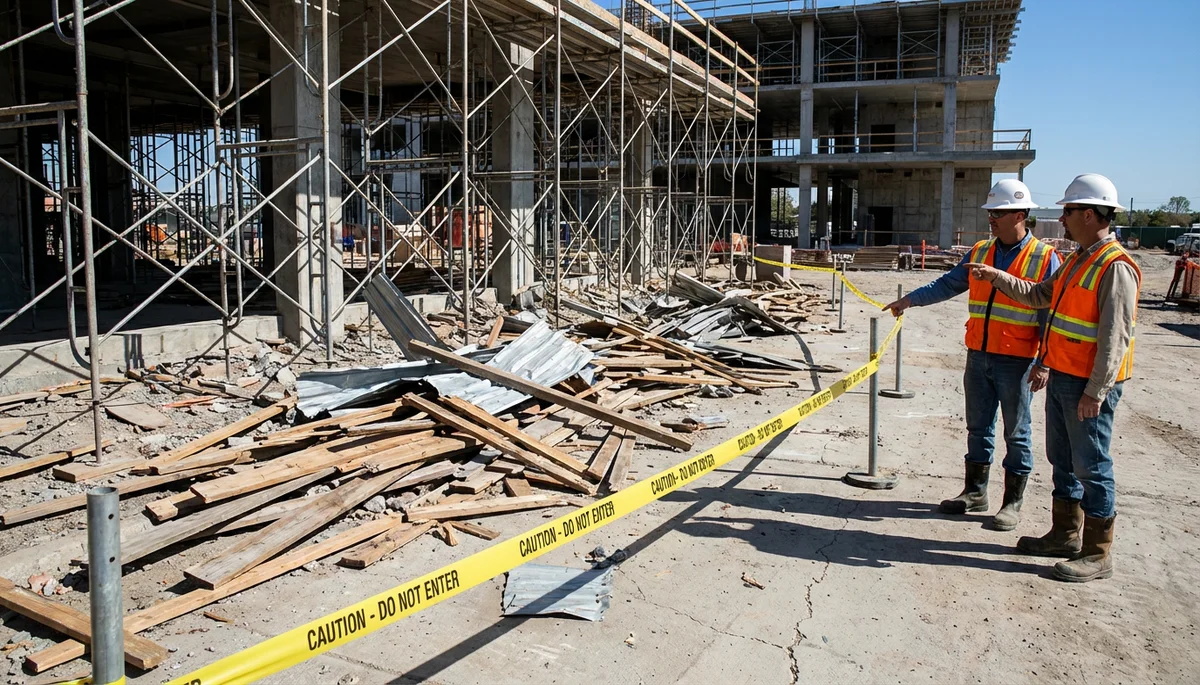
    Fallen construction materials and debris near scaffolding with caution tape and safety workers investigating, representing scaffold collapse accidents

    Proper fall protection, guardrails, and trained inspections can prevent most scaffold accidents.

    Workers’ compensation vs. personal injury claims: the dual-track approach

    Here’s where scaffold fall cases get more complicated — and where having the right attorney matters most. Most injured construction workers know about workers’ compensation. But many don’t realize they may also have a separate personal injury claim against a third party.

    Workers’ compensation

    If you’re an employee (not an independent contractor), you’re entitled to workers’ comp benefits regardless of who was at fault. Workers’ comp covers medical treatment and a portion of your lost wages (typically two-thirds of your average weekly wage, subject to a statutory cap). It does not cover pain and suffering, and the wage replacement is often far less than what you actually earned.

    Workers’ comp is a no-fault system, meaning you don’t have to prove your employer was negligent. But there’s a trade-off: you generally can’t sue your direct employer for additional damages beyond what workers’ comp provides.

    Third-party personal injury claims

    This is where the real money is. While you can’t sue your own employer, you absolutely can sue other parties whose negligence contributed to your scaffold fall. These third parties can include:

    • The general contractor who had overall control of the job site and failed to enforce safety standards
    • The scaffold manufacturer if a defective scaffold component contributed to the fall
    • The scaffold erector if a different subcontractor set up the scaffold improperly
    • The property owner in some circumstances
    • The scaffold rental company if they provided defective equipment

    A third-party personal injury claim allows you to recover full compensatory damages — all of your medical bills, all of your lost wages (not just two-thirds), pain and suffering, disability, and loss of enjoyment of life. These claims are often worth significantly more than workers’ comp alone.

    And here’s the key: you can pursue both tracks simultaneously. You collect workers’ comp benefits while your personal injury claim against the third party is pending. If you win the personal injury case, there may be a workers’ comp lien to address, but the net recovery is almost always higher than workers’ comp alone.

    Product liability claims against scaffold manufacturers

    Sometimes the scaffold itself is the problem. If a scaffold component fails — a locking mechanism breaks, a platform collapses, a coupler gives way — the manufacturer of that component may be liable under North Carolina product liability law.

    Product liability claims can be based on:

    • A design defect — the scaffold was inherently unsafe even when used as intended
    • A manufacturing defect — a specific component was flawed due to a production error
    • A failure to warn — the manufacturer didn’t provide adequate warnings or instructions about the product’s limitations

    These claims require technical evidence, often involving engineering experts who can examine the failed component and testify about what went wrong. Preserving the scaffold components after an accident is critical — if the evidence gets disposed of or returned to service, it becomes much harder to prove a product defect.

    What to do after a scaffold fall accident

    If you or a coworker has been injured in a scaffold fall on an NC construction site, take these steps as soon as possible:

    1. Get medical treatment immediately. Scaffold fall injuries are serious. Don’t let anyone on the job site talk you out of going to the ER.
    2. Report the injury to your employer. This starts the workers’ comp process and creates an official record.
    3. Document the scene. If you’re able, take photos of the scaffold, the area where you fell, any missing safety equipment, and your injuries. If you can’t, ask a trusted coworker to do it.
    4. Don’t give detailed statements to anyone other than medical personnel until you’ve spoken with an attorney. The general contractor and their insurer will start investigating quickly — and their goal is to minimize liability, not to help you.
    5. Contact an attorney who handles construction accident cases. The sooner you have legal representation, the sooner someone can preserve evidence, identify all liable parties, and protect your rights. If you were injured on a construction site in the Belmont, Charlotte, or greater Gaston County area, reach out to my office for a free consultation.

    Contributory negligence in scaffold fall cases

    North Carolina is one of the few states that still follows the contributory negligence rule. This means that if you were even 1% at fault for your accident, the defendant can argue that you’re barred from recovering anything.

    In scaffold fall cases, defendants will try to argue that the worker was careless — not wearing a harness, ignoring safety rules, or working on a scaffold they knew was unsafe. An experienced construction accident attorney knows how to counter these arguments. The reality is that employers and general contractors have a duty to provide safe working conditions, and workers shouldn’t be blamed for hazards they didn’t create and couldn’t control.

    Frequently asked questions

    Can I sue my employer if I fell from a scaffold at work?

    Generally, no. North Carolina’s workers’ compensation law provides the exclusive remedy against your direct employer. But you can sue third parties — like the general contractor, scaffold manufacturer, scaffold erector, or property owner — whose negligence caused or contributed to your fall. These third-party claims often result in significantly higher compensation than workers’ comp alone.

    What if I’m an independent contractor, not an employee?

    If you’re a true independent contractor, you may not be covered by workers’ compensation. The upside is that you’re also not limited by the workers’ comp exclusive remedy — meaning you may be able to sue the hiring company directly, as well as other third parties. Be aware that many construction companies misclassify employees as independent contractors. An attorney can help you determine your actual legal status.

    How long do I have to file a scaffold fall injury claim in NC?

    For a personal injury claim, the statute of limitations in North Carolina is generally three years from the date of injury. For workers’ compensation, you must report the injury to your employer within 30 days, and file a claim with the NC Industrial Commission within two years. Don’t wait — evidence deteriorates, witnesses forget details, and scaffold components get discarded or put back into service.

    What kind of compensation can I recover after a scaffold fall?

    Through workers’ comp, you can recover medical expenses and partial wage replacement. Through a third-party personal injury claim, you can recover full medical expenses, full lost wages (past and future), pain and suffering, disability, loss of enjoyment of life, and in some cases punitive damages. The combined recovery from both tracks is almost always greater than either one alone.

    Hurt in a scaffold fall? I’ll investigate every angle and fight for the full compensation you deserve.

    Free Consultation
    Call 704-741-9399

    This blog post is for general informational purposes only and does not constitute legal advice. Every case is different, and outcomes depend on the specific facts and circumstances involved. Contact the Law Office of Ryan P. Duffy for a free consultation to discuss your specific situation.

  • How Much Is My Car Accident Case Worth in North Carolina?

    How Much Is My Car Accident Case Worth in North Carolina?

    “How much is my case worth?” It’s the first question almost every car accident client asks me. And the honest answer is: it depends. There’s no formula, no calculator, and no shortcut that can give you a reliable number without understanding the specific facts of your case.

    I say that not to dodge the question but because I’ve seen how car accident claims are actually valued — from both sides. Before I represented injured people, I worked as an insurance defense attorney. I’ve watched adjusters run their internal calculations. I’ve seen how they assign dollar values to pain. And I can tell you that the way insurance companies value your claim has very little to do with what’s fair.

    Medical bills and documents from a car accident claim in North Carolina

    The value of your car accident case depends on many factors — and none of them involve an online calculator.

    The factors that actually determine what your case is worth

    Every car accident case in North Carolina is different. But there are consistent categories of damages that determine value. Let me walk through the real factors.

    Medical expenses

    Your medical bills are the foundation of your claim’s value. This includes emergency room visits, hospital stays, surgeries, physical therapy, chiropractic treatment, prescription medications, imaging (MRIs, X-rays, CT scans), and any future medical care you’ll need.

    The total matters, but so does the type of treatment. Insurance companies look closely at whether your treatment was “reasonable and necessary” — a phrase you’ll hear a lot. They’ll scrutinize your medical records for gaps in treatment, question whether certain procedures were warranted, and sometimes hire their own doctors to say you didn’t need the care you received.

    Future medical expenses are often where the real value lies, especially in cases involving herniated discs, torn ligaments, traumatic brain injuries, or other conditions that require ongoing care. Proving future medical needs requires solid medical evidence and sometimes expert testimony.

    Lost wages and earning capacity

    If the accident caused you to miss work, you’re entitled to recover those lost wages. This is pretty straightforward for salaried employees — your employer provides a letter documenting the time missed and the income lost.

    It gets more complicated for self-employed individuals, commission-based workers, and people whose injuries have permanently reduced their ability to earn a living. Lost earning capacity is different from lost wages. It’s about what you could have earned in the future but can’t anymore because of your injuries. Proving this often requires an economist or vocational expert.

    Pain and suffering

    This is the category that confuses most people — and the one where insurance companies have the most room to lowball you. Pain and suffering is a legal term for the physical pain, emotional distress, and diminished quality of life caused by your injuries.

    There’s no fixed formula for calculating pain and suffering in North Carolina. It’s subjective. A jury (or an adjuster during settlement negotiations) considers things like: How severe was the pain? How long did it last? Did it affect your ability to enjoy life, sleep, exercise, or spend time with family? Is the pain permanent?

    The insurance company will try to minimize this number as much as possible. They’ll point to gaps in treatment, argue that your injuries were pre-existing, or claim you’re exaggerating. Your job — and your attorney’s job — is to document the real impact of the injury on your daily life.

    Permanent injury and disability

    Cases involving permanent injuries are worth significantly more than soft tissue cases that resolve within a few months. If your doctor has assigned a permanent impairment rating, that changes the calculus entirely.

    Common permanent injuries from car accidents include spinal fusions, chronic pain conditions, loss of range of motion, scarring, and traumatic brain injuries. These cases require long-term documentation and often medical expert opinions about your prognosis.

    Property damage

    While property damage (your vehicle repair or total loss) is a separate claim from your injury claim, it does influence how the insurance company perceives your case. Severe vehicle damage tends to correlate with more serious injuries. A minor fender bender with a $1,500 repair bill and a claim for a herniated disc will get more scrutiny than a totaled vehicle with the same injury claim. Is that fair? Not always. But it’s how adjusters think.

    Why online calculators are misleading

    You’ve probably seen websites that promise to calculate your settlement in 60 seconds. You plug in your medical bills, click a button, and get a number. That number is meaningless.

    These calculators typically use a simple multiplier — they take your medical bills and multiply them by some factor (usually between 1.5 and 5) to estimate your total claim value. The problem is that no insurance company, no judge, and no jury uses a flat multiplier to value a case.

    The “multiplier method” is an oversimplification that insurance companies abandoned years ago. Most major insurers now use software programs like Colossus or Claims Outcome Advisor that analyze hundreds of data points to generate a claim value. These programs look at diagnosis codes, treatment types, jurisdiction, prior claims history, and dozens of other variables. A simple multiplier doesn’t come close to capturing that complexity.

    Online calculators exist for one reason: to collect your contact information and sell it to attorneys. They’re lead generation tools, not legal advice.

    Ryan’s Insider Perspective

    On the defense side, I saw how claims valuation software actually worked. The adjuster enters your medical codes, treatment timeline, and injury type into the system, and the software spits out a recommended range. That range is almost always conservative — it’s designed to protect the insurance company’s bottom line, not to give you a fair number. Adjusters who consistently settle above the software’s recommendation get flagged by management. The system is built to keep payouts low.

    Person reviewing medical bills and insurance paperwork for a car accident claim

    Your medical bills are just the starting point — the real value of your claim goes well beyond the numbers on paper.

    How insurance companies actually value claims

    Having been on the inside, I can tell you that insurance companies consider several things when they put a number on your claim.

    Liability clarity. How strong is the evidence that their insured caused the accident? If liability is disputed, the value goes down — not because your injuries are worth less, but because North Carolina’s contributory negligence rule means any hint of shared fault could eliminate the claim entirely.

    The severity and type of injury. Insurance companies categorize injuries internally. Soft tissue injuries (sprains, strains, whiplash without objective findings) are valued lower than injuries with objective medical evidence like fractures, disc herniations on MRI, or surgical interventions.

    Treatment consistency. Gaps in medical treatment hurt your claim. If you stop going to the doctor for three months and then resume treatment, the insurance company will argue you weren’t really hurt during that gap. They want to see a consistent treatment timeline that matches the severity of your claimed injuries.

    The jurisdiction. Where your case would be tried matters. Some NC counties have jury pools that tend to award higher verdicts. Others are more conservative. Insurance companies track verdict data by county and adjust their valuations accordingly. A case in Mecklenburg County might be valued differently than the same case in a rural county.

    The attorney (or lack of one). Insurance companies track attorney reputations. They know which attorneys file lawsuits and go to trial, and which ones always settle. Claims handled by unrepresented individuals are consistently valued lower because the insurance company knows there’s no threat of litigation. That’s not opinion — it’s industry data. Studies have shown that people with attorneys receive significantly higher settlements on average, even after attorney fees.

    Things that can reduce your case value

    Some factors work against you. Being aware of them can help you avoid mistakes that cost you money.

    Pre-existing conditions. If you had a prior back injury and the accident aggravated it, the insurance company will argue your current pain is related to the old injury, not the accident. You’re still entitled to compensation for aggravation of a pre-existing condition under NC law, but it complicates the case and gives the insurer a reason to offer less.

    Social media activity. I can’t stress this enough. If you’re claiming serious injuries and posting photos of yourself at the gym or on vacation, the insurance company will find those posts. Defense attorneys routinely review plaintiffs’ social media accounts. What you post can and will be used against you.

    Delayed medical treatment. If you waited two weeks after the accident to see a doctor, the insurance company will question whether the accident actually caused your injuries. See a doctor as soon as possible after any accident — even if you think you’re okay. Adrenaline masks pain, and some injuries don’t show symptoms for days. I’ve written more about what to do after a car accident to protect yourself.

    Recorded statements. Giving a recorded statement to the insurance adjuster without legal guidance can lock you into a version of events that hurts your claim. Be careful what you say early on.

    Settlement vs. trial: how the path affects value

    Most car accident cases in NC settle before trial. But the possibility of trial is what gives your settlement negotiations teeth. If the insurance company knows you’re willing to go to court, they’ll value your case higher than if they think you’ll take whatever they offer.

    Trial verdicts in NC car accident cases can vary wildly. A soft tissue case might settle for $15,000 to $30,000 but could get a defense verdict (zero) at trial because of contributory negligence. A serious injury case with clear liability might settle for $250,000 but could get a jury verdict of $500,000 or more.

    The decision to settle or go to trial involves weighing the guaranteed money of a settlement against the risk and potential reward of trial. That’s a conversation every client should have with their attorney, and it should be based on the specific facts of the case — not on some generic formula. Keep in mind there are also deadlines for filing your claim that affect your timeline.

    Frequently asked questions

    Is there an average settlement for a car accident in North Carolina?

    There’s no meaningful “average” because cases vary so widely. A minor whiplash case might settle for $5,000 to $15,000, while a case involving surgery and permanent injury could settle for hundreds of thousands or more. Anyone quoting you an average settlement without knowing the details of your case is guessing.

    How long does it take to settle a car accident case in NC?

    Most car accident cases take anywhere from several months to a couple of years to resolve, depending on the complexity. You generally shouldn’t settle until you’ve reached maximum medical improvement (MMI) — the point where your doctors say your condition has stabilized. Settling too early means you might not account for future medical expenses or permanent impairments.

    Does the insurance company’s first offer reflect what my case is worth?

    Almost never. The first offer is typically a lowball — sometimes dramatically so. Insurance companies expect negotiation. Their initial offer is based on what they think you’ll accept, not what your case is actually worth. Having an attorney negotiate on your behalf usually results in a significantly higher outcome.

    Will I get more money if I hire a lawyer?

    Statistically, yes. Research consistently shows that injured people who hire attorneys receive higher settlements on average — even after paying attorney fees — than those who handle claims on their own. An attorney knows how to document your damages, counter the insurance company’s tactics, and leverage the threat of litigation to get you a fair result.

    Want to know what your car accident case is really worth? Get a free, no-obligation case evaluation.

    Free Consultation
    Call 704-741-9399

    This blog post is for general informational purposes only and does not constitute legal advice. Every case is different, and outcomes depend on the specific facts and circumstances involved. Contact the Law Office of Ryan P. Duffy for a free consultation to discuss your specific situation.
  • Can I Sue My Neighbor If Their Dog Bit Me in North Carolina?

    Can I Sue My Neighbor If Their Dog Bit Me in North Carolina?

    Yes, you can file a claim if your neighbor’s dog bit you in North Carolina. But here’s what most people don’t realize: you’re not really suing your neighbor. You’re filing a claim against their homeowner’s insurance policy. The insurance company pays the settlement, not your neighbor out of pocket.

    I’m Ryan Duffy, a personal injury attorney in Belmont, NC. I used to defend insurance companies — including homeowner’s insurers — against dog bite claims. I know exactly how these cases work from both sides. And I can tell you that the fear of “ruining the relationship” stops too many people from getting compensation they’re owed for serious injuries.

    Residential neighborhood in North Carolina where a dog bite incident could occur between neighbors

    Most neighbor dog bite claims are resolved through homeowner’s insurance — not personal lawsuits.

    You’re filing an insurance claim, not a personal lawsuit

    This is the single most important thing to understand. When an attorney sends a demand letter after a dog bite, it goes to the neighbor’s homeowner’s insurance company. The insurer assigns an adjuster. The adjuster evaluates the claim. If there’s a settlement, the insurance company writes the check.

    Your neighbor doesn’t pay a dime out of pocket in most cases. Their premiums might go up, but that’s between them and their insurer. This is exactly what homeowner’s insurance is designed to cover.

    I’ve handled these claims from the insurance side. The adjusters don’t take it personally. It’s a business transaction. And your neighbor probably won’t even be involved in the negotiations.

    North Carolina’s dog bite laws: the one-bite rule and strict liability

    North Carolina has two paths to holding a dog owner liable for a bite. Which one applies depends on the circumstances.

    The one-bite rule (common law negligence)

    Under the traditional common law rule, a dog owner is liable if they knew or should have known the dog was dangerous. This is sometimes called the “one-bite rule” because if a dog has bitten before — or shown aggressive tendencies like growling, lunging, or snapping — the owner is on notice.

    Evidence that the owner knew about the danger includes prior bites, complaints from other neighbors, aggressive behavior toward people or other animals, and the owner’s own statements about the dog being “mean” or “protective.”

    Strict liability for dogs running at large

    Under NCGS § 67-4.1, if a dog is running at large at night and causes injury, the owner is strictly liable. That means you don’t have to prove the owner knew the dog was dangerous. The fact that the dog was loose and uncontrolled is enough.

    There’s also NCGS § 67-4.4, which applies to dogs declared “dangerous” or “potentially dangerous” by local animal control. If a dog has that designation and bites someone, the owner faces strict liability regardless of the time of day.

    Many local ordinances in Gaston County and Mecklenburg County also require dogs to be leashed or confined. Violating a leash law can be evidence of negligence on its own.

    What damages can you recover from a neighbor’s dog bite?

    Dog bite injuries often cost more than people expect. A single emergency room visit with stitches can run $3,000 to $10,000. If the bite requires plastic surgery — which is common for facial bites — costs climb fast.

    Compensation in a North Carolina dog bite claim can include:

    • Emergency room and hospital bills
    • Surgery, including plastic or reconstructive surgery
    • Follow-up medical care and physical therapy
    • Prescription medications and antibiotics
    • Lost wages from missed work
    • Pain and suffering
    • Scarring and disfigurement
    • Emotional distress, including fear of dogs

    Most homeowner’s insurance policies have liability coverage between $100,000 and $300,000. That’s usually more than enough to cover a dog bite claim.

    Ryan’s Insider Perspective

    When I defended insurance companies, I saw how adjusters evaluated neighbor dog bite claims. They actually prefer settling these quickly because the liability is usually clear and the damages are well-documented with medical records. What slows things down is when the injured person waits too long to file or doesn’t get proper medical treatment. The adjuster uses gaps in treatment to argue the injuries weren’t that serious.

    Dog bite wound requiring medical attention and documentation for an insurance claim

    Document your injuries with photos and get medical treatment right away — adjusters look for gaps in treatment.

    Steps to take after a neighbor’s dog bites you

    What you do in the first few days after a dog bite matters for your claim. Here’s what I tell every client:

    Get medical treatment immediately

    Go to urgent care or the ER. Dog bites carry a real risk of infection, and some require stitches or antibiotics. The medical records from this visit become the foundation of your claim. If you wait a week to see a doctor, the insurance company will question how badly you were actually hurt.

    Report the bite to animal control

    File a report with your local animal control office. In Gaston County, that’s Gaston County Animal Care and Enforcement. In Mecklenburg County, it’s Charlotte-Mecklenburg Animal Care and Control. The report creates an official record and may trigger a dangerous dog investigation.

    Document everything

    Take photos of your injuries on the day of the bite and every few days as they heal (or don’t heal). Save any text messages between you and your neighbor about the incident. Write down exactly what happened while it’s fresh in your memory. Note whether the dog was on a leash, behind a fence, or running loose.

    Don’t give a recorded statement to the insurance company

    If your neighbor’s insurer calls you, be polite but don’t give a recorded statement without talking to an attorney first. I used to coach adjusters on how to get statements that could be used to reduce claims. It’s not a fair conversation. Talk to a dog bite attorney before you talk to the adjuster.

    Contributory negligence: North Carolina’s harsh rule

    North Carolina is one of only a few states that follows the contributory negligence rule. If you were even 1% at fault for the dog bite, the insurance company can deny your entire claim.

    In dog bite cases, the insurer might argue you were contributorily negligent because you were teasing the dog, you entered the neighbor’s property without permission, you ignored warning signs, or you reached over a fence to pet the dog.

    This is why documentation matters so much. If you can show you were on public property or your own property, doing nothing to provoke the dog, contributory negligence won’t apply.

    How long do you have to file a dog bite claim in NC?

    The statute of limitations for personal injury in North Carolina is three years from the date of the injury under NCGS § 1-52. If you don’t file a lawsuit within three years, you lose your right to recover compensation entirely.

    That said, don’t wait three years. Evidence disappears, witnesses forget details, and the insurance company will question why you waited. The sooner you start the process, the stronger your claim will be.

    Frequently asked questions

    Will my neighbor know I filed a claim against their insurance?

    Yes, your neighbor will be notified that a claim has been filed. But the insurance company handles everything from there. Your neighbor doesn’t pay the settlement, doesn’t negotiate with your attorney, and doesn’t have to appear in court unless the case goes to trial — which is rare in dog bite cases.

    What if my neighbor doesn’t have homeowner’s insurance?

    If your neighbor is uninsured, you’d have to sue them personally and collect from their personal assets. This is uncommon but it happens, especially with renters who don’t carry renter’s insurance. An attorney can help you figure out whether it’s worth pursuing.

    What if the dog has never bitten anyone before?

    You can still recover compensation. If the dog was running at large, the owner violated a local leash law, or there’s evidence the dog showed aggressive tendencies before the bite, you don’t need to prove a prior bite. The “one-bite rule” doesn’t actually give every dog one free bite.

    Can I file a claim if I was bitten on my neighbor’s property?

    Yes, as long as you were lawfully on the property. If you were invited over, walking to the front door, or had implied permission to be there, the owner can still be held liable. The analysis changes if you were trespassing.

    Bitten by a neighbor’s dog? Let’s talk about your options — without making things awkward.

    Free Consultation
    Call 704-741-9399

    This blog post is for general informational purposes only and does not constitute legal advice. Every case is different, and outcomes depend on the specific facts and circumstances involved. Contact the Law Office of Ryan P. Duffy for a free consultation to discuss your specific situation.

  • The Insurance Company Offered Me a Settlement. Should I Take It?

    The Insurance Company Offered Me a Settlement. Should I Take It?

    If you’ve been in a car accident and the insurance company just offered you a settlement, your first instinct might be to take it. The bills are piling up, you’re missing work, and here’s a check that could make some of that stress go away. I get it. But before you sign anything, you need to understand what that offer actually represents — and why it’s almost certainly less than what your case is worth.

    I’m a personal injury attorney in Belmont, NC, and before I started representing injured people, I worked as an insurance defense lawyer. I’ve seen the internal process from the other side. I know how adjusters calculate their initial offers, what authority limits look like, and exactly why that first number is designed to close your case cheap.

    Insurance settlement offer letter on desk with pen

    That settlement check might look tempting — but the first offer rarely reflects what your claim is actually worth.

    Why the first offer is almost always too low

    Insurance companies don’t make money by paying claims generously. They make money by collecting premiums and investing that float. Every dollar they pay out in claims is a dollar off the bottom line. That’s not cynicism — it’s just how the business works.

    When an adjuster sends you a settlement offer early in your case, they’re testing you. They want to know: will this person accept a quick payout? If the answer is yes, the insurance company just saved itself tens of thousands of dollars — sometimes more.

    The first offer typically accounts for your current medical bills (sometimes not even all of them) and maybe a small multiplier for pain and suffering. What it almost never accounts for:

    • Future medical treatment you haven’t had yet
    • The full extent of your lost wages, including future earning capacity
    • Ongoing pain and how it affects your daily life
    • The long-term consequences of your injuries

    If you’re still treating for your injuries, accepting a settlement now means you’re giving up the right to seek compensation for anything that develops later. Once you sign that release, you’re done. The insurance company knows this. They’re counting on it.

    How insurance adjusters calculate settlement offers

    Here’s what happens on the other side of your claim. When your file lands on an adjuster’s desk, they run it through an evaluation. Most large insurers use software — Colossus is the big one — that spits out a value range based on your injuries, treatment, and the jurisdiction you’re in.

    The adjuster then gets “authority” from their supervisor to settle the claim within a certain dollar range. That initial authority is almost always at the low end of what the case is worth. The adjuster’s job is to settle within that authority. If they can close your case for less than their authority, that’s a win for them.

    Here’s what goes into their calculation:

    Medical specials

    This is the total of your medical bills. Adjusters look at the billed amounts, but they also consider what was actually paid (which is usually less, thanks to insurance adjustments and write-offs). Some adjusters will try to base the offer on the paid amount rather than the billed amount, which can cut the value of your claim significantly.

    Type of treatment

    Insurance companies value treatment with orthopedic surgeons and neurologists more than treatment with chiropractors. That’s not a comment on the quality of care — it’s just how the industry works. If your treatment has been exclusively chiropractic, expect the adjuster to discount your claim compared to someone who saw a specialist.

    Gaps in treatment

    If you took a break from treatment — even for a legitimate reason like work obligations or childcare — the adjuster will use that gap against you. In their evaluation, gaps in treatment equal gaps in pain, which means a lower offer.

    Liability disputes

    If there’s any question about who caused the accident, the adjuster will discount the offer. North Carolina follows a pure contributory negligence rule, which means if you’re even 1% at fault, you could be barred from recovering anything. Adjusters love to raise contributory negligence arguments to push settlement values down.

    Ryan’s Insider Perspective

    When I worked defense, I saw adjusters get bonuses based on how far under their settlement authority they closed cases. The adjuster sitting across the table from you is financially incentivized to pay you less. That first offer? It’s their opening bid in a negotiation — not a fair evaluation of what happened to you.

    Common tactics insurers use to pressure you into accepting

    Insurance companies have a playbook, and they run it on unrepresented claimants every single day. Here are some of the tactics I see most often:

    The urgency play: “This offer is only good for 30 days.” They want you to feel like the clock is ticking. In reality, you have three years to file a personal injury lawsuit in North Carolina (the statute of limitations). Don’t let artificial deadlines push you into a bad decision.

    The sympathy act: “I really want to help you, but this is the best I can do.” The adjuster isn’t your friend. They work for the insurance company. Their job is to minimize what the company pays.

    The doubt seed: “Well, you did have some pre-existing back issues.” Everyone over the age of 30 has some pre-existing something on their medical records. Having a pre-existing condition doesn’t mean the accident didn’t make it worse. Under NC law, a defendant takes the plaintiff as they find them — that’s the eggshell plaintiff doctrine.

    The recorded statement trap: Before the offer, they may have asked you for a recorded statement. If you gave one, they’ll comb through every word looking for inconsistencies they can use to justify a lower number.

    Person reviewing insurance settlement documents

    Understanding what’s in (and what’s missing from) a settlement offer is the first step toward getting fair compensation.

    What a fair settlement actually looks like

    A fair settlement fully compensates you for:

    • All past medical bills related to your injuries
    • Future medical treatment you’ll need (physical therapy, surgery, medication)
    • Lost wages from time missed at work
    • Lost earning capacity if your injuries affect your ability to work long-term
    • Pain and suffering — both physical pain and the emotional toll of living with an injury
    • Loss of enjoyment of life — the things you used to do that you can’t do anymore

    There’s no magic formula. Every case is different. But a fair settlement should make you feel like the number reflects what actually happened to you — not just what the insurance company could get away with paying.

    I tell my clients: if you’re still treating, it’s too early to settle. You don’t know the full picture yet. Once you’ve reached maximum medical improvement and we know the full scope of your injuries, that’s when we can evaluate whether an offer is fair. If you want to understand the timeline better, read my post on how long you have to file a car accident claim in North Carolina.

    When it makes sense to accept a settlement offer

    I’m not going to tell you that every settlement offer is bad. Sometimes the insurance company does come to the table with a reasonable number. That can happen when:

    • Liability is clear and undisputed
    • Your injuries are well-documented and you’ve completed treatment
    • The offer accounts for all your damages, including future medical needs
    • Taking the case to trial carries meaningful risk (every case has risk)
    • The policy limits are low and the offer is at or near those limits

    The decision to accept or reject a settlement is always yours. My job is to give you the information you need to make that decision with confidence. If the offer is fair, I’ll tell you. If it’s not, I’ll tell you that too — and we’ll talk about the next steps.

    What to do if you’ve already received an offer

    If you’ve got a settlement offer sitting on your kitchen table right now, here’s my advice:

    1. Don’t sign anything yet
    2. Don’t call the adjuster to discuss the offer
    3. Make copies of everything — the offer letter, the release, any correspondence
    4. Talk to a personal injury attorney before you make a decision

    A consultation is free at my office and there’s no obligation. I’ll review the offer, look at your medical records, and give you an honest assessment of whether the number is fair. If I think you can do better, I’ll explain why and how. If you’ve been in a car accident in North Carolina, don’t let the insurance company set the terms.

    Frequently asked questions

    Can I negotiate a settlement offer on my own?

    You can try. But you’re negotiating against a trained professional who does this every day, has access to your recorded statements, and is backed by a legal team. Most people who negotiate on their own end up leaving money on the table because they don’t know how to value their claim or counter the adjuster’s arguments.

    How long do I have to accept or reject a settlement offer?

    The offer letter might say 30 days, but that’s the insurance company’s deadline — not a legal one. In North Carolina, you have three years from the date of the accident to file a lawsuit (N.C.G.S. 1-52). As long as you’re within that window, you have time to evaluate the offer properly.

    What happens if I reject the settlement offer?

    Rejecting an offer doesn’t end your case. It just means the negotiation continues. Your attorney will send a counteroffer explaining why your case is worth more. If negotiations stall, the next step is usually filing a lawsuit, which opens up additional settlement opportunities through the litigation process, including mediation.

    Will I get more money if I hire a lawyer?

    Research consistently shows that injured people who hire lawyers recover significantly more than those who don’t — even after paying attorney fees. The Insurance Research Council has published data on this. And from my experience on the defense side, I can tell you that adjusters treat claims differently when a lawyer is involved. The offers go up.

    Got a settlement offer you’re not sure about? I’ll review it for free and tell you if it’s fair.

    Free Consultation
    Call 704-741-9399

    This blog post is for general informational purposes only and does not constitute legal advice. Every case is different, and outcomes depend on the specific facts and circumstances involved. Contact the Law Office of Ryan P. Duffy for a free consultation to discuss your specific situation.

  • OSHA Violations and Your Construction Injury Claim: What You Need to Know

    OSHA Violations and Your Construction Injury Claim: What You Need to Know

    If you were hurt on a construction site where OSHA violations existed, you might think your injury case is a slam dunk. An OSHA citation proves the site was unsafe, right? It’s strong evidence, yes. But it doesn’t automatically win your case — and understanding why that distinction matters could make or break your claim.

    I’m Ryan Duffy, a personal injury attorney in Belmont, NC. Before I started representing injured workers, I spent years as an insurance defense attorney. I’ve been on the other side of these cases. I’ve seen how defense teams try to minimize OSHA violations, and I know what it takes to use them effectively in a construction injury lawsuit.

    Construction site with safety violation warning signs and scaffolding

    OSHA violations at a construction site can be powerful evidence in your injury claim — but they’re not the whole story.

    What OSHA does and doesn’t do

    OSHA — the Occupational Safety and Health Administration — sets and enforces workplace safety standards. When OSHA investigates a construction site and finds a violation, it issues a citation. That citation might come with fines, required corrective actions, and a detailed report about what was wrong.

    What OSHA does not do is award money to injured workers. OSHA citations are regulatory actions — they punish the employer for violating safety rules. They don’t, on their own, establish that the employer is liable for your injuries in a civil lawsuit. Those are two separate legal tracks.

    That said, the findings from an OSHA investigation can become some of the most compelling evidence in your personal injury case. The key is understanding how to use them.

    How OSHA violations connect to your injury claim

    In North Carolina, to win a construction accident injury claim, you need to prove that someone was negligent — that they failed to act with reasonable care, and that failure caused your injuries. OSHA violations can support that negligence argument in several ways.

    The per se negligence argument

    In many jurisdictions, violating a safety regulation can establish what’s called “negligence per se.” The idea is straightforward: if a law or regulation exists to protect people like you from the exact type of harm you suffered, then violating that regulation is automatically negligent. You don’t need to prove the defendant “should have known better” — the violation itself is the proof.

    North Carolina courts have recognized this principle in various contexts. If OSHA’s fall protection standard (29 CFR 1926.501) requires guardrails on elevated work surfaces, and your employer didn’t install them, and you fell — that violation is strong evidence of negligence. The regulation existed to prevent exactly what happened to you.

    Evidence of the standard of care

    Even when per se negligence doesn’t apply directly, OSHA standards establish what a reasonable construction company should be doing. If OSHA says trenches deeper than five feet need shoring, that’s the industry standard. A company that ignores that standard is going to have a hard time arguing it acted reasonably.

    I use OSHA standards to frame the question for juries: here’s what the federal government says is the minimum level of safety required. The defendant didn’t even meet the minimum. That’s a powerful argument.

    Documented proof from a government investigation

    An OSHA investigation report isn’t just someone’s opinion. It’s a government inspector’s documented findings, often including photographs, measurements, witness interviews, and detailed descriptions of what was wrong. That kind of evidence carries weight with juries. It’s harder for a defendant to dismiss a government agency’s findings than to argue against an expert witness they claim is biased.

    Ryan’s Insider Perspective

    When I was on the defense side, OSHA citations were the evidence we hated seeing most. We’d argue they were “just regulatory” and “not admissible to prove negligence,” but the reality is that a documented government finding that the site was unsafe is devastating for a defendant. Now that I represent injured workers, I make sure we get those records into evidence.

    The most common OSHA violations on construction sites

    OSHA publishes its most frequently cited violations every year, and construction consistently dominates the list. Here are the violations I see most often in injury cases:

    Fall protection (29 CFR 1926.501)

    This is the number one most cited OSHA violation year after year. The standard requires fall protection — guardrails, safety nets, or personal fall arrest systems — for workers at heights of six feet or more in construction. Falls are the leading cause of death in the construction industry, and the lack of proper fall protection is almost always at the center of those tragedies.

    Scaffolding (29 CFR 1926.451)

    Scaffold-related violations include improper construction, missing guardrails, inadequate planking, and failure to inspect scaffolding before each use. Workers fall from improperly built scaffolds regularly, and these injuries tend to be severe — broken bones, spinal cord damage, traumatic brain injuries.

    Trenching and excavation (29 CFR 1926.651)

    Trench collapses kill workers quickly and with little warning. OSHA requires protective systems — sloping, shoring, or trench boxes — for excavations five feet deep or more. Despite this, contractors routinely skip these protections because they cost money and slow down the job. The result is workers being buried alive in preventable collapses.

    Ladders (29 CFR 1926.1053)

    Ladder violations include using damaged ladders, improper setup, failure to extend ladders three feet above the landing surface, and not securing ladders against displacement. These might sound like minor issues until someone falls twenty feet because a ladder shifted.

    Hazard communication (29 CFR 1926.59)

    Construction workers are exposed to hazardous chemicals — solvents, adhesives, silica dust, lead paint — and OSHA requires employers to train workers about those hazards and provide safety data sheets. When workers are injured by chemical exposure they weren’t warned about, this violation becomes central to the case.

    OSHA inspection report documents and safety violation records

    OSHA investigation records include detailed findings that can become critical evidence in your injury case.

    How to obtain OSHA investigation records

    If OSHA investigated the site where you were injured, you can request copies of the investigation records. There are a few ways to do this:

    File a FOIA request. Under the Freedom of Information Act, you can request OSHA investigation files from the U.S. Department of Labor. This includes inspection reports, citations, photographs, witness statements, and the employer’s response. FOIA requests can take weeks or months, so it’s important to file early.

    Check OSHA’s online database. OSHA maintains a searchable database of inspections and citations at osha.gov. You can search by employer name, location, or SIC code. The online records won’t include everything from the investigation file, but they’ll tell you whether a citation was issued and for what violations.

    Request records through your attorney. An experienced construction accident attorney will know how to obtain OSHA records efficiently and may already have working relationships with the local OSHA area office. Your attorney can also subpoena records during litigation if needed.

    One important note: if OSHA hasn’t investigated your job site injury, you can file a complaint with OSHA yourself. You have the right to report unsafe working conditions, and your employer cannot legally retaliate against you for doing so.

    Why OSHA violations don’t automatically win your case

    I want to be honest about the limitations. An OSHA citation, by itself, isn’t a guaranteed verdict in your favor. Here’s why:

    Causation still matters. You need to prove that the OSHA violation actually caused your injury. If the site had a fall protection violation but you were hurt by a falling object, the fall protection citation doesn’t directly help your case. The violation has to be connected to your specific injury.

    Defendants will fight admissibility. Defense attorneys routinely argue that OSHA citations shouldn’t be admitted into evidence in civil cases. They’ll claim the citation is hearsay, that it’s unduly prejudicial, or that the OSHA standards don’t apply to the specific situation. A skilled plaintiff’s attorney needs to be prepared for these challenges.

    NC’s contributory negligence rule. North Carolina is one of only a few states that follows pure contributory negligence. If the defense can prove you were even slightly at fault for your own injury, you could be barred from any recovery. Even with an OSHA violation on your side, the defense will look for any way to shift blame to you.

    Workers’ compensation complications. If you were an employee of the company that committed the OSHA violation, workers’ comp may be your exclusive remedy against that employer. However, you may still have a third-party claim against other contractors, site owners, or equipment manufacturers — and OSHA violations can be powerful evidence in those claims.

    Who you can sue after a construction site injury

    Construction sites involve multiple parties, and the OSHA violation might point to negligence by someone other than your direct employer. Potential defendants in a construction injury case include:

    The general contractor, who has overall responsibility for site safety. If the GC failed to enforce OSHA standards across the site, they may be liable for your injuries — even if you worked for a subcontractor.

    The property owner, who may have a duty to ensure the site is safe for workers. Property owners who hire contractors to perform construction work can be held responsible if they knew about unsafe conditions and failed to address them.

    Other subcontractors whose negligence contributed to your injury. If another sub’s crew created a hazard — removed guardrails, left an excavation unshored — and you were injured as a result, that subcontractor may be liable.

    Equipment manufacturers, if defective tools, machinery, or safety equipment contributed to your injury. A product liability claim doesn’t require proving negligence — just that the product was defective and caused harm.

    What to do if you’ve been hurt on a construction site with OSHA violations

    Time matters in these cases. OSHA records can be harder to obtain as time passes, witnesses’ memories fade, and evidence at the construction site will change as work continues. Here’s what I recommend:

    Report the injury immediately — to your employer, to the general contractor, and to OSHA if the violation hasn’t been reported yet.

    Get medical treatment and follow your doctor’s instructions. Your medical records create a documented connection between the accident and your injuries.

    Document everything. Take photos of the site, the hazardous condition, any safety equipment (or lack of it), and your injuries. Write down the names of witnesses, supervisors, and anyone who was present.

    Don’t give a recorded statement to any insurance company without talking to an attorney first. The defense will be looking for anything to use against you.

    Contact a construction accident attorney who understands both OSHA regulations and North Carolina personal injury law. These cases are too complex to handle alone.

    Frequently asked questions

    Can I sue my employer for an OSHA violation?

    If you’re an employee, workers’ compensation is generally your exclusive remedy against your direct employer in North Carolina, regardless of OSHA violations. However, you may have a third-party claim against the general contractor, property owner, other subcontractors, or equipment manufacturers. An attorney can evaluate who is potentially liable in your specific case.

    How long do I have to file a construction injury lawsuit in NC?

    North Carolina’s statute of limitations for personal injury is generally three years from the date of injury. But don’t wait that long. Evidence disappears, OSHA records become harder to obtain, and the construction site will continue to change. The sooner you take action, the stronger your case will be.

    Will OSHA investigate my construction accident automatically?

    OSHA investigates workplace fatalities, hospitalizations, amputations, and losses of an eye. For other injuries, OSHA may investigate if a complaint is filed. If OSHA hasn’t investigated your accident, you or your attorney can file a complaint to trigger an inspection. You’re protected from employer retaliation for filing an OSHA complaint.

    Does the OSHA fine amount matter for my injury case?

    The fine itself doesn’t directly determine your damages. However, the severity of the citation — whether it’s classified as “serious,” “willful,” or “repeat” — can be relevant. A willful violation, where OSHA found the employer intentionally disregarded the standard, is especially powerful evidence for your case and may support a claim for punitive damages.

    Hurt on a construction site? Let’s talk.

    I’ve handled construction injury cases from both sides. I know how the defense will use — and try to minimize — OSHA violations. Let me put that experience to work for you.

    Get a free case review

    Or call (704) 741-9399

    The information on this page is for general informational purposes only and does not constitute legal advice. Every case is different. Contacting Ryan P. Duffy Law does not create an attorney-client relationship. Past results do not guarantee future outcomes.

  • Pedestrian Right-of-Way Laws in North Carolina: What Drivers and Walkers Need to Know

    Pedestrian Right-of-Way Laws in North Carolina: What Drivers and Walkers Need to Know

    “Pedestrians always have the right of way” is one of the most repeated — and most wrong — statements about North Carolina traffic law. The actual rules are more specific than that. Pedestrians have the right of way in some situations and don’t in others. And because NC follows contributory negligence, getting the details right can mean the difference between recovering full compensation and getting nothing.

    I’m Ryan Duffy, a personal injury attorney in Belmont. I spent years defending insurance companies before switching sides to represent injured people. I’ve seen adjusters deny pedestrian accident claims based on right-of-way technicalities that the injured person didn’t even know existed. Here’s what the law actually says.

    Crosswalk at an intersection in North Carolina illustrating pedestrian right-of-way laws

    NC pedestrian right-of-way rules depend on where and how you’re crossing — not a blanket rule that walkers always go first.

    What NCGS 20-174 actually says about pedestrian right of way

    The primary statute governing pedestrian rights in North Carolina is NCGS § 20-174. It doesn’t say pedestrians always have the right of way. It sets up different rules depending on the situation.

    At intersections with crosswalks (and no traffic signals)

    Under NCGS § 20-174(a), vehicles must yield to pedestrians who are within a crosswalk at an intersection that doesn’t have a traffic signal or a police officer directing traffic. This is the closest thing to “pedestrians have the right of way” in NC law — and even this comes with conditions.

    The pedestrian has to be in or entering the crosswalk. A pedestrian standing on the curb waiting to cross hasn’t yet entered the crosswalk. Drivers are supposed to yield, but the pedestrian doesn’t have an absolute right to step out into traffic and expect cars to stop.

    At intersections with traffic signals

    When a traffic signal is present, pedestrians must obey the signal. NCGS § 20-174(b) says pedestrians can cross only on a green light or a “Walk” signal. Crossing against a red light or a “Don’t Walk” signal means the pedestrian doesn’t have the right of way — even in a crosswalk.

    Crossing between intersections (mid-block crossing)

    This is where it gets tricky. Under NCGS § 20-174(a), when crossing at any point other than a marked crosswalk or unmarked crosswalk at an intersection, the pedestrian must yield the right of way to vehicles. In plain English: jaywalking means you don’t have the right of way.

    That doesn’t mean a driver can hit a jaywalking pedestrian with no consequences. Drivers still have a duty to exercise due care to avoid hitting pedestrians regardless of who has the right of way. But the pedestrian’s decision to cross mid-block creates a serious contributory negligence problem for any injury claim.

    Walking along roadways

    NCGS § 20-174(d) requires pedestrians walking along a highway to use the sidewalk if one is available. If there’s no sidewalk, pedestrians must walk on the left side of the road, facing oncoming traffic. Walking with traffic — on the right side — is a violation.

    Contributory negligence and pedestrian accident claims

    North Carolina’s contributory negligence rule makes these right-of-way details matter more than they would in almost any other state. In 46 states, if you were 10% at fault for the accident, your compensation is reduced by 10%. In North Carolina, if you were 1% at fault, you get nothing.

    Insurance adjusters handling pedestrian claims in NC will look for any right-of-way violation to deny the claim entirely. Common arguments I’ve seen from the defense side:

    • The pedestrian was crossing mid-block instead of at the crosswalk
    • The pedestrian stepped into the crosswalk against a “Don’t Walk” signal
    • The pedestrian was wearing dark clothing at night
    • The pedestrian was looking at their phone while crossing
    • The pedestrian was walking with traffic instead of against it

    Any one of these can sink a claim if the insurer can build a contributory negligence argument around it.

    Ryan’s Insider Perspective

    When I defended insurance companies, contributory negligence was our most powerful weapon in pedestrian cases. The strategy was simple: find anything the pedestrian did wrong, no matter how minor, and argue they were partially at fault. It didn’t matter that the driver was speeding or ran a red light. If the pedestrian was texting while walking, that was enough to deny the whole claim. This is why documenting the exact circumstances of how you were crossing — and that you had the right of way — is so important.

    Pedestrian crossing signal at a North Carolina intersection showing walk and don't walk indicators

    Obeying walk signals isn’t just about safety — it’s about protecting your legal rights under NC’s contributory negligence rule.

    Drivers’ duties to pedestrians under NC law

    The law doesn’t just put obligations on pedestrians. Drivers have duties too, and violating them creates liability for the driver even when the pedestrian wasn’t in a crosswalk.

    Under NCGS § 20-174(a), drivers must exercise “due care” to avoid colliding with any pedestrian on the roadway. They must give warning by sounding the horn when necessary. This duty applies everywhere — not just at crosswalks.

    NCGS § 20-141.1 also prohibits excessive speed in school zones, which have heavy pedestrian traffic. And NCGS § 20-174(e) gives a specific right of way to blind pedestrians using a white cane or guide dog at all intersections.

    If a driver was speeding, distracted, impaired, or failed to yield where required, the driver is negligent regardless of what the pedestrian was doing. The challenge in NC is proving the pedestrian wasn’t also negligent — which brings us back to contributory negligence.

    The “last clear chance” exception

    There’s one major exception to contributory negligence in North Carolina that helps pedestrians: the last clear chance doctrine. Even if the pedestrian was partially at fault (crossing mid-block, for example), the pedestrian can still recover if the driver had the last clear chance to avoid the collision and failed to act.

    For this to apply, the driver must have seen — or should have seen — the pedestrian in time to stop or swerve, and failed to do so. This doctrine has saved many pedestrian claims that would otherwise be barred by contributory negligence.

    A pedestrian accident attorney can evaluate whether the last clear chance doctrine applies to your case.

    What to do if you’re hit by a car as a pedestrian in NC

    If you’re struck by a vehicle while walking, the steps you take immediately after matter for your health and your legal claim.

    • Call 911 and get a police report filed at the scene
    • Get medical attention right away — even if injuries seem minor
    • Document the exact location where you were walking or crossing
    • Note whether you were in a crosswalk and what the traffic signal showed
    • Get contact information from witnesses
    • Take photos of the scene, your injuries, and the vehicle if possible
    • Don’t give a recorded statement to the driver’s insurance company

    For a detailed guide on protecting your rights after any accident, read what to do after an accident in North Carolina. And remember the three-year statute of limitations — it applies to pedestrian claims too.

    Frequently asked questions

    Do pedestrians always have the right of way in North Carolina?

    No. Pedestrians have the right of way in marked crosswalks at intersections without traffic signals. At signalized intersections, pedestrians must obey the traffic signal. When crossing outside a crosswalk (jaywalking), the pedestrian must yield to vehicles. The blanket “pedestrians always have the right of way” rule is a myth in NC.

    Can I still recover compensation if I was jaywalking when I was hit?

    Possibly. North Carolina’s contributory negligence rule could bar your claim if you were crossing outside a crosswalk. But the last clear chance doctrine may still apply if the driver saw you or should have seen you in time to stop. An attorney can evaluate the specific facts of your case.

    What is an “unmarked crosswalk” in North Carolina?

    An unmarked crosswalk exists at every intersection, even where there are no painted lines. It’s the natural extension of the sidewalk or shoulder across the intersection. Pedestrians have the same right-of-way protections in unmarked crosswalks as in marked ones — many people don’t realize this.

    What side of the road should pedestrians walk on in NC?

    If there’s a sidewalk, use it. If there’s no sidewalk, walk on the left side of the road facing oncoming traffic. This is required by NCGS § 20-174(d). Walking on the right side with traffic is a violation and could be used as evidence of contributory negligence if you’re struck.

    Hit by a car while walking? Right-of-way questions can make or break your claim. Let’s talk.

    Free Consultation
    Call 704-741-9399

    This blog post is for general informational purposes only and does not constitute legal advice. Every case is different, and outcomes depend on the specific facts and circumstances involved. Contact the Law Office of Ryan P. Duffy for a free consultation to discuss your specific situation.

  • Should I Give a Recorded Statement to the Insurance Company After an Accident?

    Should I Give a Recorded Statement to the Insurance Company After an Accident?

    Within days of a car accident, your phone will ring. It’ll be an insurance adjuster — friendly, concerned, maybe even sympathetic. They’ll say they just want to “get your side of the story” and ask if you’d mind giving a recorded statement. It sounds reasonable. It isn’t.

    I spent years as an insurance defense attorney. I’ve reviewed hundreds of recorded statements, and I can tell you exactly what the adjuster is doing: building a case against you. Every question they ask has a purpose, and that purpose isn’t to help you get fair compensation.

    Person receiving a phone call from an insurance adjuster after a car accident

    That friendly call from the insurance adjuster isn’t as innocent as it sounds.

    What is a recorded statement?

    A recorded statement is exactly what it sounds like — the insurance company asks you questions while recording your answers, usually over the phone. Sometimes they’ll call it an “interview” or say they’re just “taking your statement for the file.” The recording can be audio, or the adjuster may type it up and ask you to sign it later.

    There are two types you might encounter. The at-fault driver’s insurance company (the third-party insurer) may call and ask for one. Your own insurance company might also request a statement, especially if you’re filing a UM/UIM claim. The rules are a bit different depending on which company is asking, and I’ll get into that below.

    Why the other driver’s insurance company wants your statement

    Let me be blunt: the other driver’s insurance company is not on your side. They have one goal — pay you as little as possible, or nothing at all. The recorded statement is a tool to accomplish that goal.

    Adjusters are trained to ask questions in specific ways. They’re not just collecting facts. They’re looking for inconsistencies, admissions, and anything they can use to argue contributory negligence — which in North Carolina can completely eliminate your right to compensation.

    The questions are designed to trap you

    An adjuster might ask, “Did you see the other car before the impact?” If you say no, they’ll argue you weren’t keeping a proper lookout. If you say yes, they’ll ask why you didn’t take evasive action. Either answer can be used against you.

    “How are you feeling today?” Sounds like small talk. It’s not. If you say “I’m doing okay,” that statement will show up in a letter denying your injury claim. They’ll say you told them you were fine shortly after the accident.

    “Can you describe exactly what happened?” You’re being asked to give a detailed account while you’re still in pain, possibly on medication, and dealing with the stress of the accident. You might get a detail wrong. You might say something imprecise. That inconsistency will be used to undermine your credibility later.

    They’re locking you into a story

    One of the most effective things about a recorded statement is that it locks you into a version of events early — before you’ve had a chance to fully understand what happened, get all your medical records, or consult with an attorney. If your account changes later (because you remembered something, or new evidence came to light), the insurance company will use the recorded statement to argue you’re not credible.

    I’ve seen it happen dozens of times. A person gives an honest statement two days after a crash, then three months later their medical records show injuries they didn’t mention in the statement because the symptoms hadn’t appeared yet. The insurance company points to the statement and says, “You never mentioned neck pain when we talked to you. You must be exaggerating.”

    Ryan’s Insider Perspective

    When I reviewed recorded statements on the defense side, I was specifically looking for three things: admissions of any fault (even partial), inconsistencies between the statement and other evidence, and minimization of injuries. A single sentence like “I guess I could have been paying more attention” was often enough to build an entire contributory negligence defense around. The person thought they were being honest and humble. The insurance company saw it as a signed confession.

    Are you legally required to give a recorded statement?

    If the other driver’s insurance company asks for a recorded statement, the answer is simple: no, you are not required to give one. You have no contractual relationship with the at-fault driver’s insurer. They have no legal right to demand a statement from you. You can politely decline, and you should.

    The adjuster might push back. They might imply that your claim can’t move forward without a statement, or that refusing makes you look like you have something to hide. That’s a pressure tactic. Your claim doesn’t depend on cooperating with the other side’s investigation.

    What about your own insurance company?

    This is where it gets more complicated. Your own auto insurance policy likely includes a “cooperation clause” that requires you to assist with the investigation of any claim. If you’re filing a claim under your own policy — like a UM/UIM claim — your insurer may have a contractual right to request a statement.

    But even then, you have rights. You can have an attorney present. You can schedule it at a reasonable time. You don’t have to answer questions that go beyond the scope of the claim. And your attorney can object to questions that are designed to harm your case rather than investigate the facts.

    Insurance adjuster reviewing accident claim documents at desk

    Adjusters are trained professionals. They ask questions for a reason — and that reason isn’t to help your claim.

    What to do when the adjuster calls

    If you get that call — and you will — here’s what I tell my clients.

    Be polite but firm. You can say, “I’m not comfortable giving a recorded statement at this time. I’d like to speak with an attorney first.” That’s it. You don’t need to explain further or justify your decision.

    Don’t discuss the accident in detail. You can confirm basic information — your name, the date of the accident, your insurance policy number. But don’t describe what happened, how you’re feeling, or anything about your injuries. Keep it short.

    Don’t say you’re “fine” or “okay.” This is a natural response when someone asks how you’re doing. But in the context of an injury claim, those words will be used to minimize your injuries. If the adjuster asks how you’re feeling, say you’re still being evaluated by your doctors.

    Write down who called you and when. Keep a record of every contact from the insurance company. Note the adjuster’s name, the company they represent, their phone number, and what they said. This documentation can be helpful later.

    Talk to an attorney before giving any statement. I know I’m a lawyer saying “call a lawyer,” but this is one of those situations where it genuinely matters. An experienced car accident attorney can handle communication with the insurance company, and if a statement is needed, they can prepare you and be present to protect your interests. If you’re not sure what steps to take after your accident, start there.

    Can a recorded statement help your case?

    In rare situations, yes. If the facts are overwhelmingly in your favor and there’s no question about liability or injuries, a well-prepared statement given with an attorney’s guidance can sometimes move a claim forward faster. But that’s the exception, not the rule.

    The problem is that most people don’t know which category their case falls into. And by the time you realize the statement hurt you, it’s too late — the words are already on the record. The safe play is almost always to decline the third-party statement and have your attorney manage the process.

    Frequently asked questions

    Can the insurance company deny my claim if I refuse to give a recorded statement?

    The other driver’s insurance company cannot deny your claim simply because you refused their request for a recorded statement. You have no obligation to cooperate with their investigation. Your own insurance company is different — your policy may require cooperation, but even then, you can have an attorney present and set reasonable conditions.

    What if I already gave a recorded statement?

    Don’t panic. A recorded statement doesn’t automatically destroy your case. But you should talk to an attorney as soon as possible so they can review what was said and develop a strategy to address any problematic statements. The sooner you get legal help, the more options you’ll have.

    Is a recorded statement the same as a deposition?

    No. A recorded statement is an informal interview conducted by an insurance adjuster, usually over the phone. A deposition is a formal proceeding under oath, typically conducted by an attorney during litigation, with a court reporter present. Depositions have legal protections that recorded statements don’t — including the right to have your attorney object to improper questions.

    How soon after an accident will the insurance company call?

    Fast. It’s common to get a call within 24 to 72 hours of the accident. Insurance companies move quickly because they know you’re most vulnerable right after a crash — you’re in pain, you’re stressed, and you haven’t had time to think clearly or talk to a lawyer. That speed is intentional.

    Got a call from an insurance adjuster? Talk to a former defense attorney before you say a word.

    Free Consultation
    Call 704-741-9399

    This blog post is for general informational purposes only and does not constitute legal advice. Every case is different, and outcomes depend on the specific facts and circumstances involved. Contact the Law Office of Ryan P. Duffy for a free consultation to discuss your specific situation.

  • Who Can File a Wrongful Death Lawsuit in North Carolina?

    Who Can File a Wrongful Death Lawsuit in North Carolina?

    Your loved one was killed because of someone else’s negligence. You want justice. You want accountability. You want to file a wrongful death lawsuit. But in North Carolina, there’s a rule that surprises almost every family I work with: you probably can’t file that lawsuit yourself — even if you’re the spouse, parent, or child of the person who died.

    North Carolina has one of the most restrictive wrongful death filing rules in the country. Only the personal representative of the deceased person’s estate can bring a wrongful death claim. Not the surviving spouse. Not the adult children. Not the parents. Understanding this rule — and acting on it quickly — is one of the most important steps a grieving family can take.

    Family consulting with an attorney about a wrongful death case in North Carolina

    In NC, only the estate’s personal representative can file a wrongful death lawsuit — and most families don’t know this until it’s almost too late.

    North Carolina’s wrongful death statute explained

    The law governing wrongful death in North Carolina is NCGS 28A-18-2. It’s short, but it controls everything about who can file, when they can file, and what damages can be recovered.

    The statute says that a wrongful death action must be brought by the “personal representative” of the decedent’s estate. That’s a specific legal term. It refers to the person appointed by a court to manage the affairs of someone who has died. In legal terms, this person is sometimes called the executor (if there’s a will) or the administrator (if there isn’t one).

    This is different from most states. In many states, the surviving spouse, children, or parents can file a wrongful death lawsuit directly. In North Carolina, none of them can — not individually, not as a group. Only the personal representative, acting on behalf of the estate.

    Who is the personal representative?

    If the deceased person left a will, the will usually names an executor. That person becomes the personal representative once the will is admitted to probate and the court formally appoints them.

    If there’s no will — which is common, especially with sudden deaths — the court appoints an administrator. North Carolina’s intestacy laws (NCGS Chapter 28A) determine who has priority to be appointed administrator. The general priority order is:

    1. The surviving spouse
    2. Any other person the surviving spouse nominates
    3. An adult child or children of the deceased
    4. A parent of the deceased
    5. A sibling of the deceased
    6. Any next of kin who would inherit under intestacy laws
    7. A creditor of the estate
    8. Any other qualified person the court deems appropriate

    In practice, the surviving spouse or an adult child is usually appointed. But the appointment doesn’t happen automatically. Someone has to go to the clerk of superior court in the county where the deceased person lived and petition to be appointed.

    How to get appointed as personal representative

    The process involves filing paperwork with the clerk of superior court in the county where the deceased person was domiciled at the time of death. You’ll need to provide:

    A certified copy of the death certificate. Information about the deceased’s assets, debts, and heirs. The original will, if one exists. Your own identification and information.

    The clerk will review the application, confirm you have priority to serve, and issue “letters testamentary” (if there’s a will) or “letters of administration” (if there isn’t). These letters are your formal authority to act on behalf of the estate — including filing a wrongful death lawsuit.

    The process can sometimes be completed in a single visit to the courthouse, though complications like contested wills, multiple people seeking appointment, or out-of-state issues can slow things down.

    Ryan’s Insider Perspective

    When I represented defendants in wrongful death cases, one of the first things I checked was whether the personal representative had been properly appointed. If the family filed a lawsuit without going through the appointment process, we’d move to dismiss — and we’d win. I’ve seen families lose months of time because no one told them about this requirement. Now I make sure my clients get the appointment handled before anything else.

    Why this matters for the statute of limitations

    Here’s where the urgency comes in. North Carolina’s statute of limitations for wrongful death is two years from the date of death (NCGS 1-53(4)). That clock starts running on the day the person dies — not when a personal representative is appointed.

    If no one is appointed as personal representative before the two-year deadline, the right to file a wrongful death lawsuit is lost forever. It doesn’t matter how clear the negligence was or how devastating the loss. Miss the deadline, and the case is over.

    I’ve consulted with families who came to me 18 months after a death, thinking they had plenty of time. Once we factor in the time needed to get appointed, gather evidence, and prepare the lawsuit, those remaining months disappear fast. If you’ve lost someone due to negligence, starting the process early gives your attorney the time needed to build the strongest possible case.

    Courthouse paperwork for estate administration and personal representative appointment

    Getting appointed as personal representative requires a filing with the clerk of superior court — and it must happen before the two-year statute of limitations runs out.

    What if family members disagree about who should be personal representative?

    This comes up more often than you’d expect, especially in blended families or when relationships are strained. When multiple people want to serve as personal representative — or when family members disagree about whether to even pursue a lawsuit — things get complicated.

    The clerk of superior court generally follows the priority list I mentioned above. If the surviving spouse wants to serve, they typically have first priority. But if the spouse doesn’t want the role, or if there’s a dispute about their suitability, other family members can petition the court.

    In contested situations, the court can appoint a neutral third party — sometimes an attorney who has no family connection — to serve as personal representative. This can actually simplify things in contentious family situations, because the personal representative’s job is to act in the best interests of all beneficiaries, not just one family faction.

    One thing to keep in mind: the personal representative doesn’t decide who gets the wrongful death damages. Damage distribution is determined by statute, not by the personal representative’s preferences.

    How NC compares to other states

    North Carolina’s approach is unusual. Most states allow specific family members to file wrongful death lawsuits directly:

    In South Carolina, the personal representative also must file, but the process and distribution rules differ. In Virginia, the personal representative files on behalf of statutory beneficiaries. In Georgia, the surviving spouse or children can file directly. In Florida, the personal representative files, similar to NC. In California, the surviving spouse, domestic partner, or children can file directly without estate involvement.

    The point is that NC families can’t assume the rules are the same as what they’ve heard about from friends or family in other states. North Carolina has its own system, and it requires the extra step of estate appointment.

    Who benefits from a wrongful death recovery?

    Even though the personal representative files the lawsuit, they’re doing so on behalf of specific beneficiaries defined by NCGS 28A-18-2. The statute directs that damages are distributed to the same people who would inherit under NC’s intestacy laws:

    If the deceased had a surviving spouse and one child, the spouse receives the first $100,000 of the net estate, plus one-half of the remainder. The child receives the rest. If there’s a surviving spouse and two or more children, the spouse gets the first $100,000 plus one-third of the remainder, and the children split the rest equally. If there’s no surviving spouse, the children inherit equally. If there are no children, the estate passes to parents, then siblings, according to the intestacy statutes.

    These distribution rules apply regardless of what the deceased’s will says about other property. Wrongful death proceeds are separate from the general estate.

    Steps to take after a wrongful death in North Carolina

    If your family is dealing with a wrongful death, here’s the practical path forward:

    Consult a wrongful death attorney immediately. Don’t wait until you’ve figured out the personal representative situation on your own. An experienced attorney can guide you through the appointment process, identify all potential claims, and make sure you don’t miss any deadlines.

    Start the personal representative appointment process. Whether you’re the surviving spouse, an adult child, or another family member, get the paperwork started at the clerk of superior court. Your attorney can handle this for you or assist you through it.

    Preserve evidence. In many wrongful death cases, evidence is time-sensitive. Scene conditions change. Witnesses move. Records get lost. The sooner your attorney can begin investigating, the better.

    Don’t talk to insurance companies. The at-fault party’s insurer will likely reach out to the family. They are not trying to help you. Don’t give recorded statements or sign anything without legal representation.

    Understand that this takes time. Wrongful death cases are complex. Between the appointment process, investigation, and litigation, these cases often take a year or more to resolve. But families who start early put themselves in the strongest position.

    Frequently asked questions

    Can the surviving spouse file a wrongful death lawsuit in NC?

    Not directly. In North Carolina, only the personal representative of the estate can file a wrongful death lawsuit. However, the surviving spouse has first priority to be appointed as personal representative. Once appointed by the clerk of superior court, the surviving spouse can then file and manage the wrongful death claim on behalf of all beneficiaries.

    What happens if no one is appointed as personal representative?

    If no personal representative is appointed before the two-year statute of limitations expires, the right to file a wrongful death lawsuit is permanently lost. The court won’t grant extensions simply because the family didn’t know about the requirement. This is why consulting with an attorney early is so important.

    Can a personal representative be removed or replaced?

    Yes. If a personal representative isn’t fulfilling their duties properly — including pursuing a wrongful death claim when the evidence supports it — interested parties can petition the court to have them removed and replaced. The court’s primary concern is that the estate and its beneficiaries are properly represented.

    Is there a difference between wrongful death and survival actions in NC?

    Yes. A wrongful death claim compensates the beneficiaries for their losses resulting from the death. A survival action, under NCGS 28A-18-1, allows the estate to pursue claims the deceased person would have had if they survived — such as claims for pain and suffering between the injury and death. Both are typically filed by the personal representative, but they compensate different things.

    Lost a loved one to someone’s negligence?

    I know this is an overwhelming time. Let me handle the legal process — including the personal representative appointment — so your family can focus on what matters most.

    Get a free consultation

    Or call (704) 741-9399

    The information on this page is for general informational purposes only and does not constitute legal advice. Every case is different. Contacting Ryan P. Duffy Law does not create an attorney-client relationship. Past results do not guarantee future outcomes.